The Weather: Editorial Introduction
Issue 08 of Scapegoat: Journal of Architecture, Landscape, and Political Economy was edited by Seth Denizen and Adam Bobbette in 2015.
Info
Authors
- Seth Denizen
- Adam Bobbette
Weather: Issue 08 Editors
- Seth Denizen
- Adam Bobbette
Scapegoat Editorial Board
- Adrian Blackwell
- Seth Denizen
- Elise Hunchuck
- Marcin Kedzior
- Christie Pearson
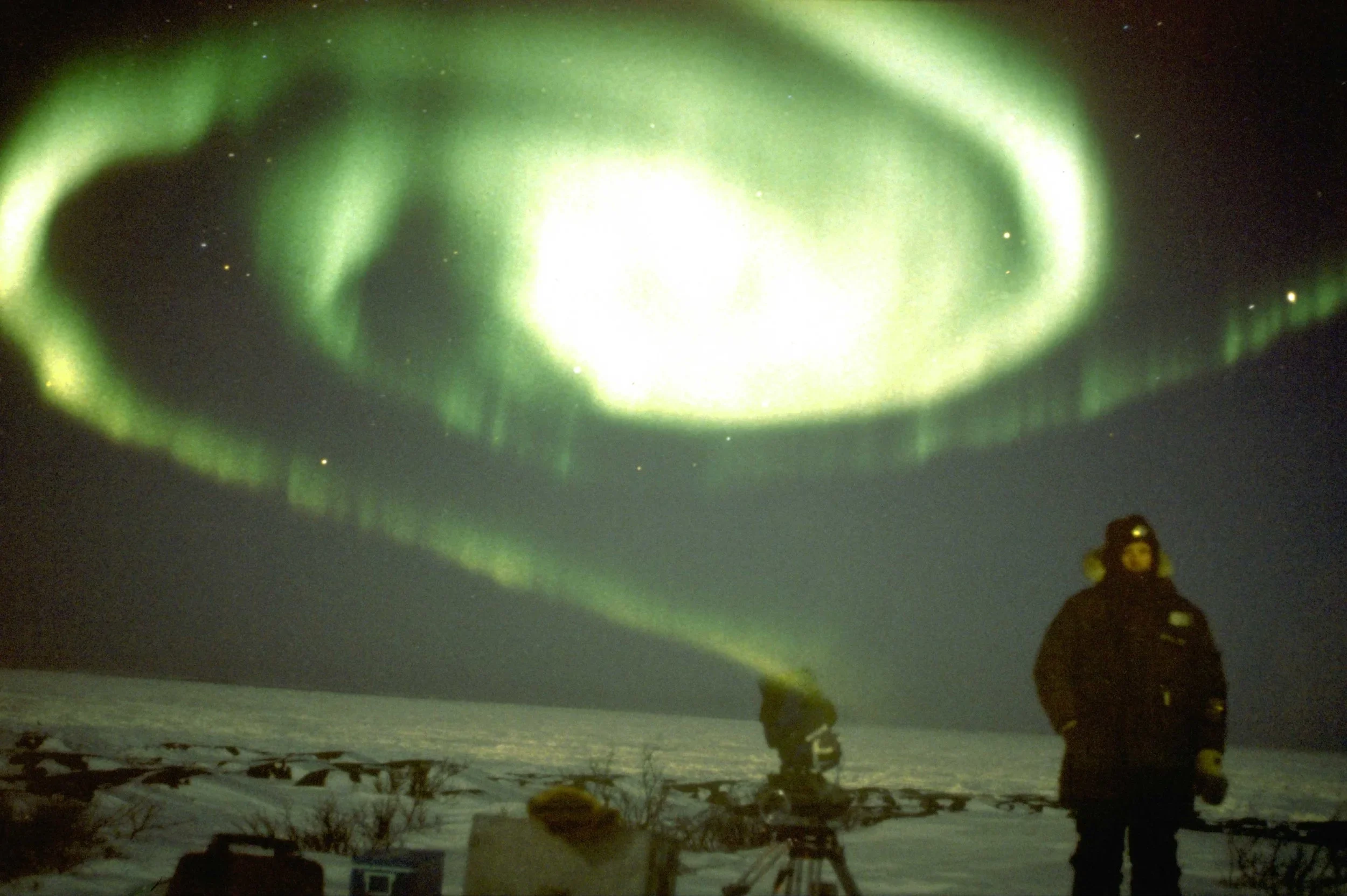
"...what happened was that by observing the weather I began to question how we perceive transformation, which then brought the focus to the more human dimension of the perception of change, or what we call time."
— Peter Mettler, Scapegoat 08
What are we talking about when we talk about the weather?
We are talking about the rain,1 the clouds,2 the air,3 the breath,4 the fog,5 the gas,6 the dust,7 the soil,8 the carbon,9 the climate,10 the bomb,11 the border,12 the math,13 the sensor,3 the sensorium,4 the satellite,7 the snow,14 the ice,15 the exorcist,15 the shaman,6 the gods,1 the future,13 the good fortune,12 the bad luck,4 and the better times ahead.5
Three concepts have guided the assembly of the texts in this issue, each of which is meant to be tested, taken up, or taken to task by the texts we have selected. These three concepts are the following:
1. A Cosmopolitical Proposal for the Goddamned Weather
There are ways of speaking about the weather outside the logic of technological mastery. This is often the way we talk about the weather when we have nothing else to say. We talk about the weather with strangers because it’s what our bodies have in common; the material relations that tether us to the Earth and keep the sky from cracking in half. Talking about the weather is a cosmological project to carefully assemble the space in which we live and to fill it with an air that we can breathe; maybe it’s an atmosphere maintained by technical devices, or one guaranteed by unknowable forces. Crucially, the way that we talk about, experience, and manipulate the weather invokes gods and cosmoses that are not necessarily compatible or lived comparably. While we often assume that our present condition operates in a secular mode, the contents of this issue demonstrate that the weather is particularly a means for us to negotiate the presence of the non-human, and even the otherworldly, in the constitution of our very human politics. Each of the following texts should be read both as a cosmopolitical proposal for how to talk about the weather, and an investigation into contemporary uncertainties about how we are to distribute agency in the age of climate change:
- ☼ In an attempt to re-build a failing relationship on the basis of clear communication, Una Chaudhuri, Marina Zurkow, and Frederick Ertl have written some letters to the climate.
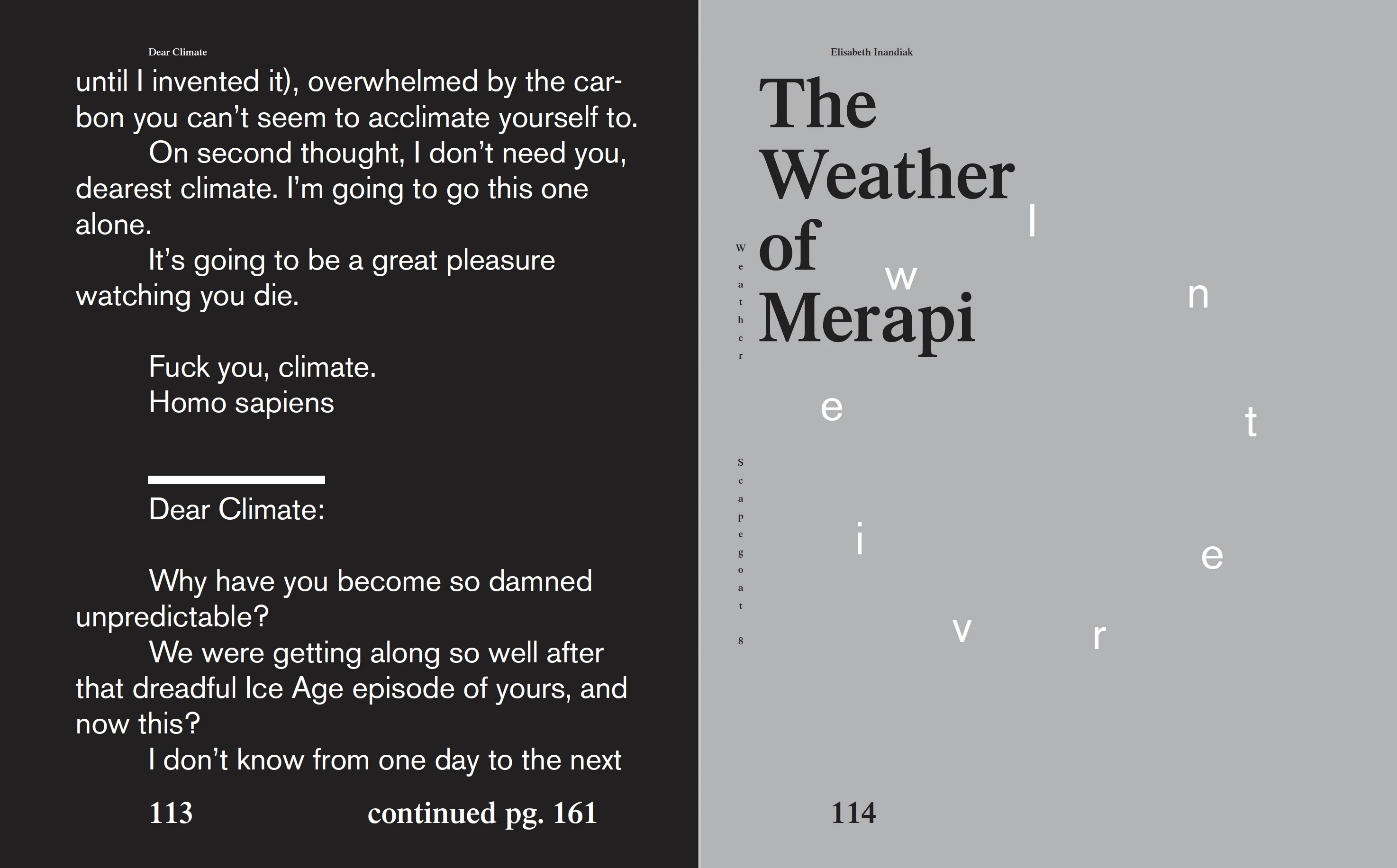
- ☼ Responding to the loquacious and excessive material utterances of the Earth, Elisabeth Inandiak reads some pages from her diary at the foot a volcano in Central Java.
- ☼ Investigating directly the words that are used to speak to and about the weather, farid rakun tracks the weatherization of political language in Indonesian national media.
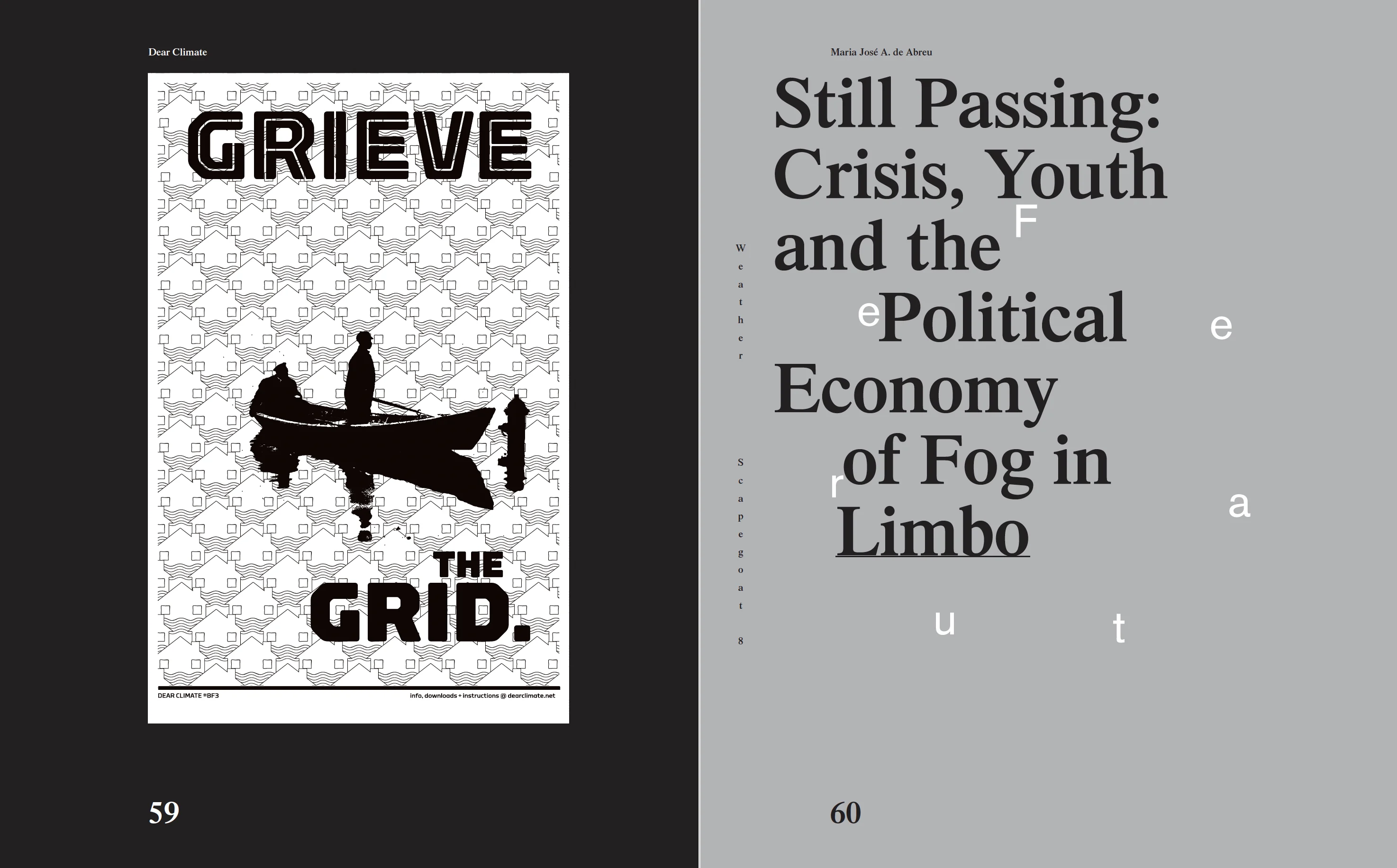
- ☼ Also exploring the weatherization of political language in both text and image, Maria José A. de Abreu takes up a dialogue with the semiotics of fog in the work of Portugese photographer Inês D’Orey.
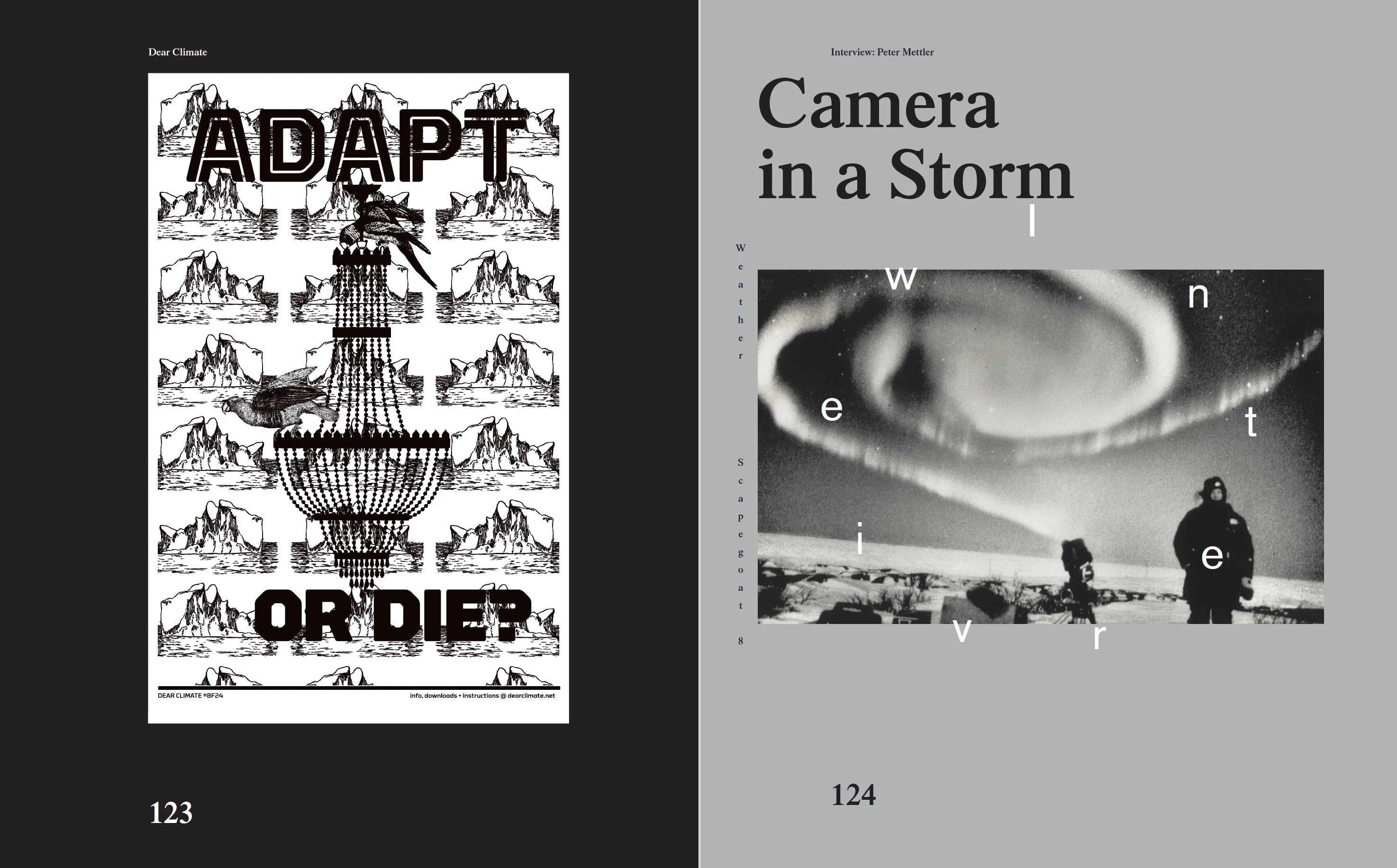
- ☼ Using the camera itself as a weather device, the Canadian documentary filmmaker Peter Mettler reminds us that the word for weather is time.
- ☼ Andrew Toland gives us a legal history of the excommunication of a glacier in the French Alps, and comes to terms with what he calls “satanic glacial agency.”
2. Our Unremarkable Present
Today we are confronted by incessant declarations from all sides that the present is a wholly remarkable place: we are in a new climate, a new war, a new world, with no precedent. While it is difficult to resist the sense that the present is marked by its exceptions to the past, such as increasingly erratic weather events and ever more dire and unequal consequences, it is important not to lose sight of the long durée and the continuities that make the present unremarkable. The modern concern with the weather reaches back to the period of the great empires of the eighteenth and nineteenth centuries in which weather knowledge had been slowly but steadily accumulating through vast and complex networks of exchange. The weather data, primarily culled by ships at sea and weather stations on land, recorded and sent back to their respective metropoles readings of precipitation, wind direction and intensity, and tidal patterns. Along with the botanical sciences and epistemologies related to resource extraction, weather observation was some of the earliest observational science in the colonies. In Indonesia, for example, weather stations were the first state-funded scientific institutions. As with other colonies, they facilitated the production of knowledge for shipping. In the nineteenth century, this was a global project where individual European states both competed to establish the most sophisticated stations in their colonies and cooperated to create networks of knowledge exchange among national scientific communities. While facilitating the circulation of commodities and people around the globe, this knowledge about the weather also bled into the public sphere through media networks in ways that look very much like they do today: reports of storms and weather events from around the globe. It was common to find weather updates in national newspapers from their colonies, such as a storm in Tonkin in the French press or the Indian monsoons in the British press. The following texts open windows onto this long durée of biopolitical control, techno-utopian fantasies, and militarization that are as sure as the seasons:
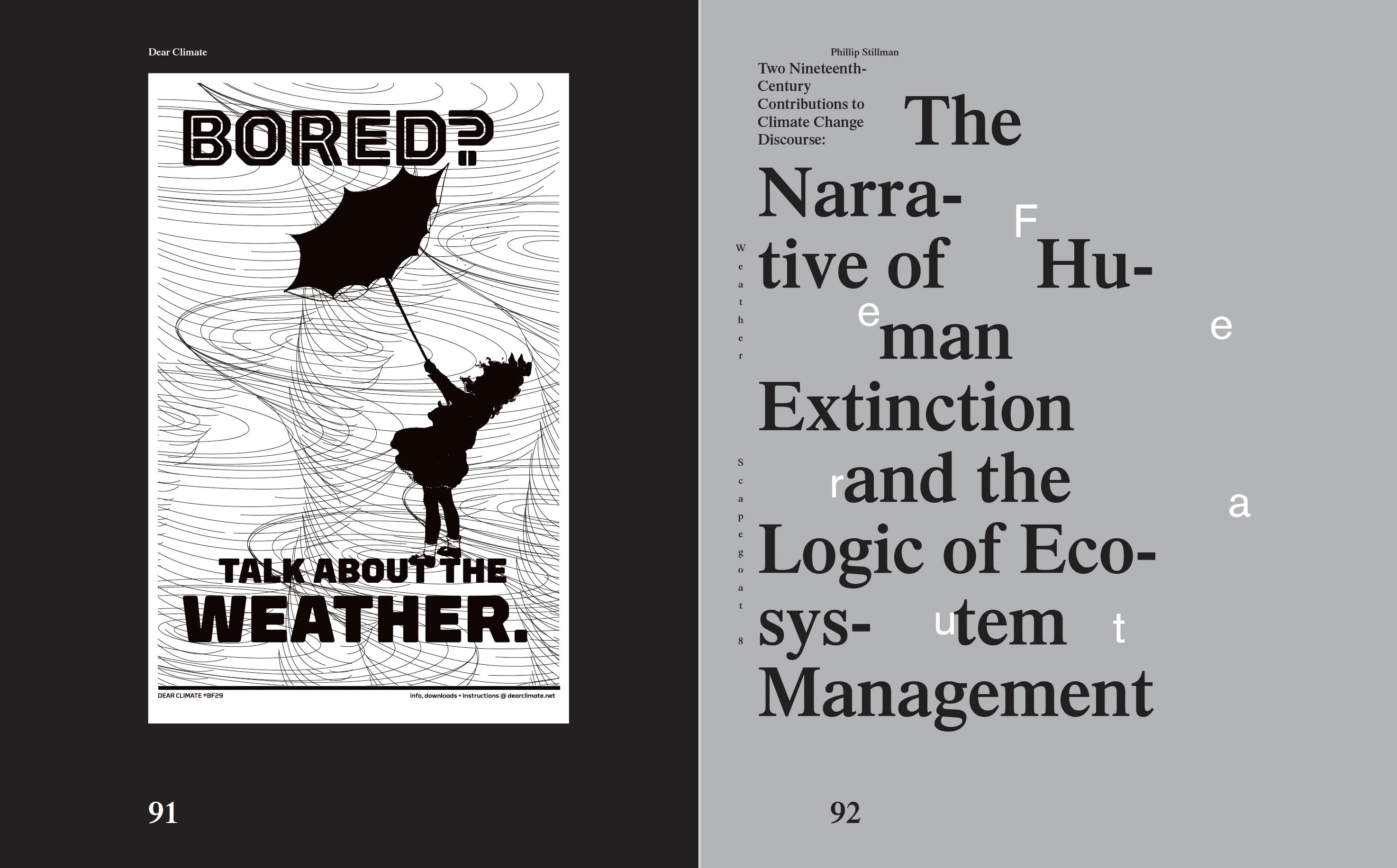
- ☼ Phillip Stillman finds the origin of the narrative of human extinction and the logic of ecosystem management in Victorian literature.
- ☼ Marijn Nieuwenhuis gives an account of the history of weather prediction in China from pre-modern log books to contemporary supercomputers.
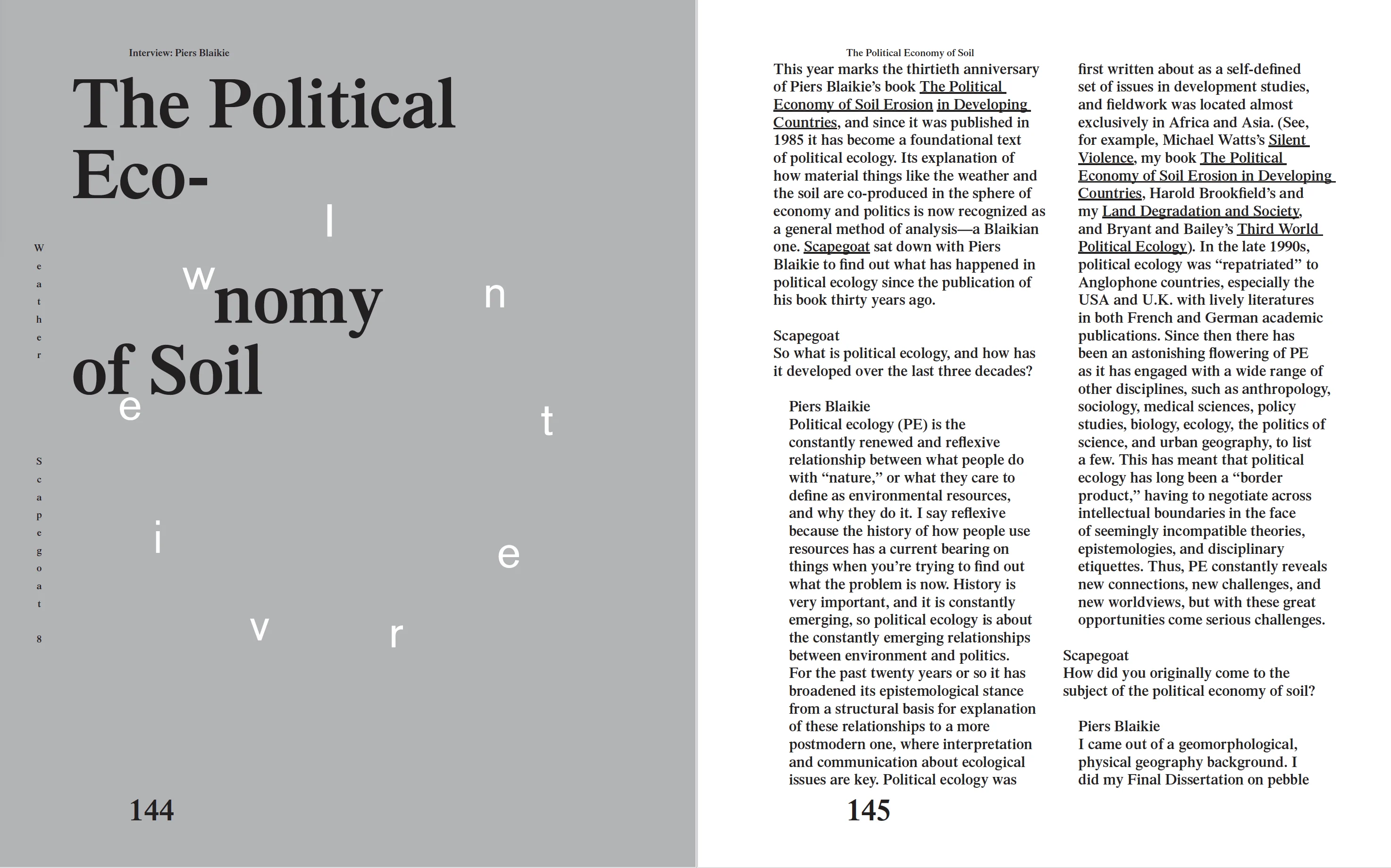
- ☼ Piers Blaikie looks back on 30 years since the publication of his classic text “The Political Economy of Soil Erosion in Developing Countries,” and takes stock of the development of political ecology as a discipline.
- ☼ The French anarchist and geographer Elisée Reclus writes the Histoire d’une Montagne in the early 1880’s, and it is given an original translation by Scapegoat.
3. In Bed With The Weather
As a container term, “the weather” has historically referred to things that occur in the atmosphere, and these things generally occur in a way that is capricious, beyond control, and beyond reproach. Today the weather is increasingly something that always exists, to some extent, as a byproduct of human decisions. Its mixture of gasses, salts, dust, and debris can be contaminated, and its intensities of heat, pressure, and moisture can be modified. Today the weather can commit a crime, and those responsible held accountable. Understanding the extent to which the weather in general is a product of human decisions is now a global juridical project. Beyond the question of liability, however, what is necessary today is a critical reassessment of how the weather happens, what its mixture consists of, and how it should entangle human life. In short, how are we to live the reality that there are no “natural” disasters? The following texts each take a single case study of a weather system that is human-made and investigate the technical and political entanglements unfolding within:
- ☼ Meredith Miller investigates the weather that is made in tornado alley by nuclear devices.
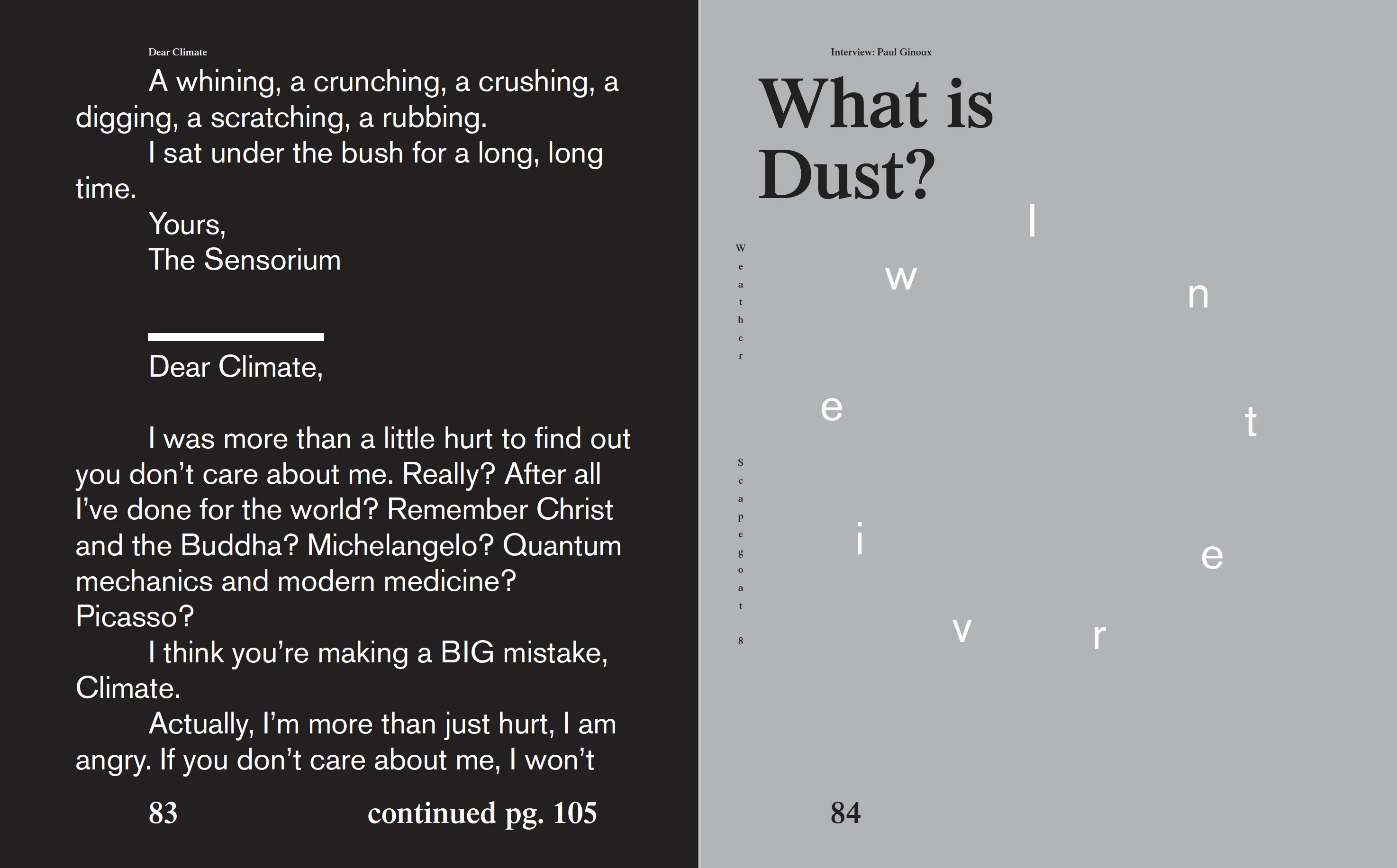
- ☼ Paul Ginoux shows us the anthropogenic dust storms that can be observed from space and is skeptical of tree planting.
- ☼ Wearing a 2.5PM breathing mask, Jerry Zee buys canned air from Tibet that is sold in Beijing.
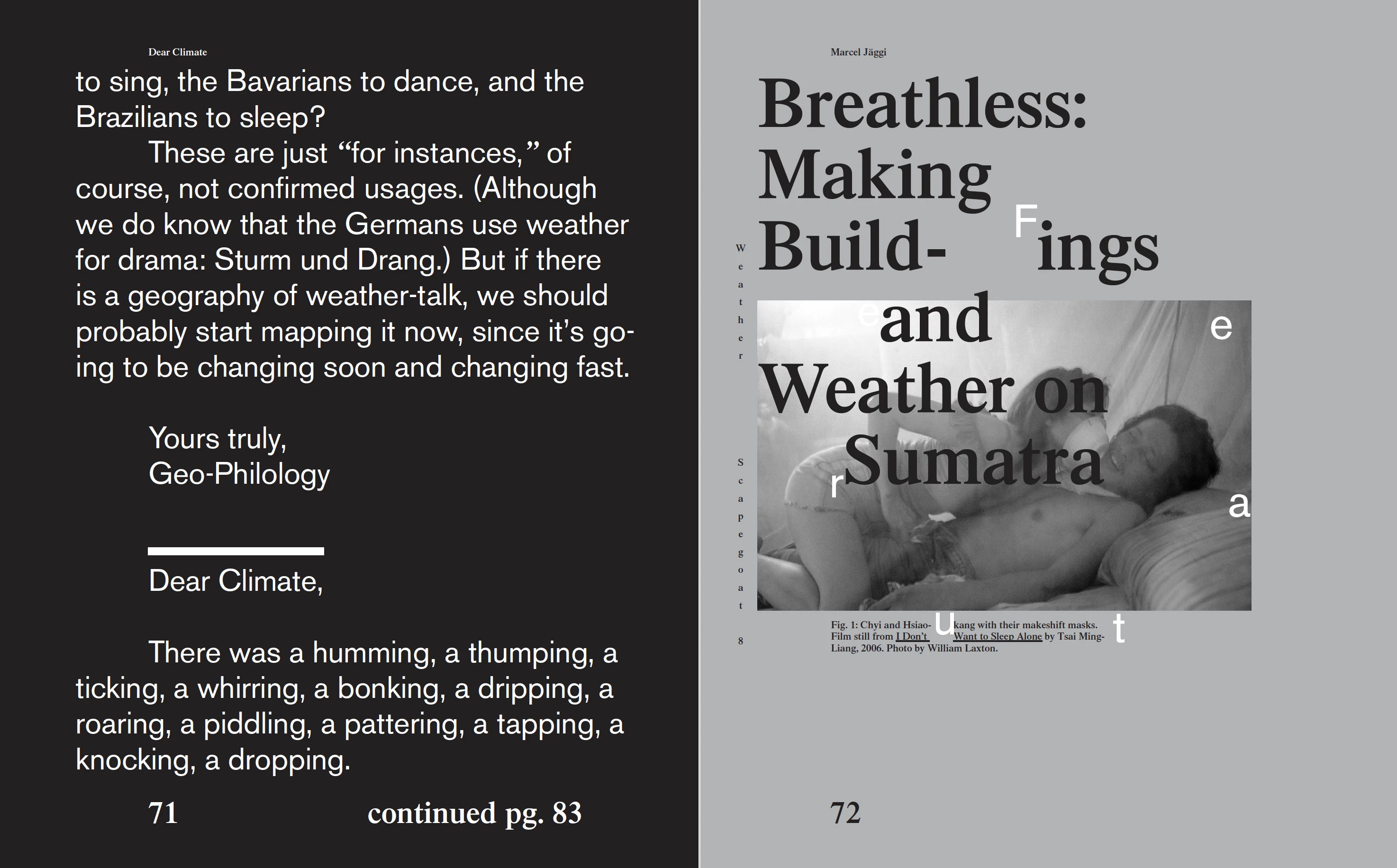
- ☼ Breathing through a cheap plastic noodle bowl, Marcel Jäggi describes the forms of life and love that arose in Malaysia in 2013 within the haze of other people’s plantation fires.
Footnotes
-
Reclus, Elisée. Histoire d’une Montagne. Bibliothèque d’éducation et de Récréation. J. Hetzel et Cie, 1882. See also this issue: Reclus, Élisée. “Excerpt: Historie d’une Montagne.” Translated by Scapegoat Editorial Board. Scapegoat: Journal of Architecture, Landscape, and Political Economy (Toronto) 08 (2015): 106–12. ↩ ↩2
-
farid rakun. "Habis Badi Gelap Pasti Terbitlah Terang Berlalu." Scapegoat: Journal of Architecture, Landscape, and Political Economy: 08 (2015): 162-69. ↩
-
Jeremy Zee. "Breathing in the City: Beijing and the Architecture of Air" Scapegoat: Journal of Architecture, Landscape, and Political Economy: 08 (2015): 48-58. ↩ ↩2
-
Marcel Jäggi. "Breathless: Making Buildings and Weather on Sumatra." Scapegoat: Journal of Architecture, Landscape, and Political Economy: 08 (2015): 72-82. ↩ ↩2 ↩3
-
Maria José A. de Abreu. "Still Passing: Crisis, Youth and the Political Economy of Fog in Limbo." Scapegoat: Journal of Architecture, Landscape, and Political Economy: 08 (2015): 60-70. ↩ ↩2
-
Elisabeth Inandiak. "The Weather of Merapi" Scapegoat: Journal of Architecture, Landscape, and Political Economy: 08 (2015): 114-22. ↩ ↩2
-
Paul Ginoux. "What is Dust?" Scapegoat: Journal of Architecture, Landscape, and Political Economy: 08 (2015): 84-90. ↩ ↩2
-
Piers Blaikie. "The Political Economy of Soil at 30." Scapegoat: Journal of Architecture, Landscape, and Political Economy: 08 (2015): 144-49. ↩
-
Una Chaudhuri, Fritz Ertl, Oliver Kellhammer, and Marina Zurkow. "Dear Climate." Scapegoat: Journal of Architecture, Landscape, and Political Economy: 08 (2015). ↩
-
Phillip Stillman. "The Narrative of Human Extinction and the Logic of Ecosystem." Scapegoat: Journal of Architecture, Landscape, and Political Economy: 08 (2015): 92-104. ↩
-
Meredith Miller. "A-bomb Tests Linked to Tornados? A Case for What Makes Weather." Scapegoat: Journal of Architecture, Landscape, and Political Economy: 08 (2015): 14-30. ↩
-
Jacob Kalmakoff, translated by Juhwa Pyun. "Weather Balloon Diplomacy." Scapegoat: Journal of Architecture, Landscape, and Political Economy: 08 (2015): 170-176. ↩ ↩2
-
Marijn Nieuwenhuis. "Knowing the Weather: Heavens and Super-Computers in China." Scapegoat: Journal of Architecture, Landscape, and Political Economy: 08 (2015): 132-43. ↩ ↩2
-
Peter Mettler. "Camera in a Storm." Scapegoat: Journal of Architecture, Landscape, and Political Economy: 08 (2015): 124-31. ↩
-
Andrew Toland. "The Exorcism of Glaciers" Scapegoat: Journal of Architecture, Landscape, and Political Economy: 08 (2015): 32-47. ↩ ↩2