"The The Flora of Bombed Areas (an Allegorical Key), was published in the edited volume "The Botanical City, edited by Matthew Gandy and Sandra Jasper, in 2020."
Info
Author
- Seth Denizen
Editors
- Matthew Gandy
- Sandra Jasper
Press
- Jovis
The The Flora of Bombed Areas (an Allegorical Key)
Just days after Germany’s surrender in May of 1945, the English botanist Edward James Salisbury gave a lecture in the Queen’s Chapel of the Savoy in London. Salisbury had made the trip from Kew Gardens, where he was director, in order to report his recent findings on the botanical diversity of London’s bomb craters in the aftermath of the Blitz. In particular, it was the rosebay willowherb (Chamaenerion angustifolium) that interested Salisbury. It “empurpled” London’s ruins every year between June and September with large conical inflorescences, 1 and was clearly a subject of broad popular interest. The Green Cross Society (a.k.a the Women’s Reserve Ambulance) had organized the lecture, and The Times of London sent a reporter to cover it.2 Salisbury presented the material as a standard botanical survey, filled with long species lists and careful statistics, but in 1945 it sounded like an allegory. The war was over, and, to a room full of survivors and ambulance drivers, Salisbury reported that new life had sprung from the ruins of the past. These were ruins that the audience found themselves sitting in, as the Savoy Chapel had been hit four times in a bombing raid that flattened the adjacent Savoy Hospital. If Walter Benjamin was correct in saying that “allegories are, in the realm of thoughts, what ruins are in the realm of things,” then it was from within the physical space of allegory that Salisbury invited his audience to see the broken Savoy Chapel as the rosebay willowherb saw it: as pure futurity.3
The strong allegorical undertow of London’s post-war ecology also pulled at R.S.R. Fitter. Another of London’s great war-time ecologists, Fitter wrote about the “Flora of bombed areas,” adding Salisbury’s observations on the botany of war to his own extensive accounting in London’s Natural History.4 For Fitter, the spirit of the blitz also stirred in London’s fauna, like the nightingales (Luscinia megarhynchos), who Fitter noted “are well known for their indifference to gun-fire,” and could be heard singing over the cacophony of London’s bombing raids. Like Salisbury’s plants growing vigorously in the ruins, Fitter celebrated the mallard ducks who began flying farther inland to enjoy the return of a tidal cycle to the Thames after the bombing of the Teddington Lock. “Animals,” Fitter observes, “being more mobile, have probably suffered less than plants from the bombing, apart from the innumerable invertebrates that have been blown sky-high along with the soil and turf.”5
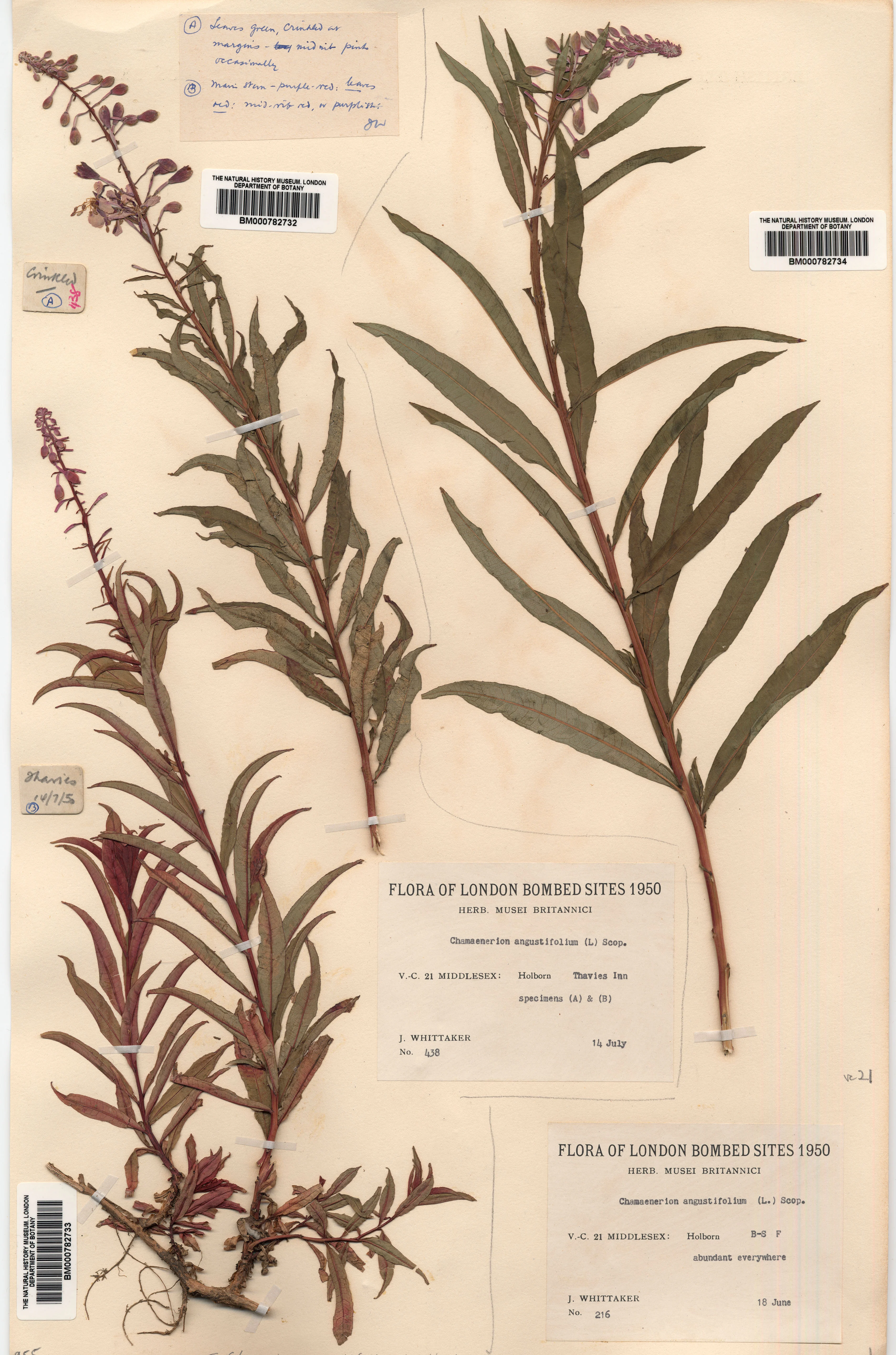
While Fitter’s natural history described a Panglossian ecology in which animals and plants thrived (or suffered less) in the traumatic aftermath of World War II, Salisbury’s project did the reverse: it was an Uexküllian ecology that tried to see the world from a plant’s point of view.6 Bombs were soil-forming events. Ruins were light-gaps. Shoes were dispersal mechanisms. For the common dandelion (Taraxacum officinale) or shepherd’s purse (Capsella bursa-pastoris), London’s bomb sites were not unlike the raw glacial till they had evolved to colonize, chasing the glaciers north as they retreated 12,000 years ago.7 Or maybe, to the few tender shoots of Sycamore (Acer pseudo-platanus L.) that Salisbury found, the bomb sites looked more like tree-fall events in a closed-canopy forest, bringing light into formerly dark areas, mixing new nutrients into the soil from the debris, and initiating a race for succession.
The observation that bombs are, among other things, botanical experiments in ecological succession was one that Salisbury was in a very good position to make. Early in his lectureship at East London College (now Queen Mary) he had discovered a chronosequence of dunes on the north coast of Norfolk where plant succession was driven by soil differences. Each dune was older than the last, offering Salisbury the opportunity to enjoy the (very Victorian) pleasure of strolling back in time as he made his way inland from the water. The age of the dunes correlated nicely with diminishing calcium as the soils acidified over time, causing changes in the species composition of the plant communities. Here, the ecological sequence was produced not by dispersal or plant competition, but by changes in the properties of the soil over time, something he termed “edaphic succession.”8 The bombing of London turned out to produce a remarkably similar kind of edaphic succession. The fire and ash introduced carbon and nitrogen into the soil, while the pulverized lime mortar used in masonry construction mixed calcium into its surface layers. For citizens, the bombs punched holes into the space of the city, but for Salisbury, the bomb sites were holes in time. Where bombs had fallen, the soil was returned to a state of youth, in which its horizons had been mixed into homogeneity with the parts of the city the bombs had mineralized. The resulting mixture was “young” in the technical sense that this new mixture showed no signs of weathering. It was also “poor” in the agricultural sense that few plants could grow there. To Salisbury, the coarse, dry, calcareous rubble of London must have looked remarkably similar to the young sandy dunes he encountered on the coast of Norfolk.
The species composition of the bomb craters not only registered changes in the soil but were also an archive of key historical shifts in the urbanization of London. Salisbury was surprised by the overwhelming abundance of the rosebay willowherb (Chamaenerion angustifolium), since William Curtis’s Flora Londinensis, published in 1777, had described it as rare in the London area. After the Great Fire of London in 1666, Salisbury reports that it was London rocket (Sisymbrium irio), rather than the willowherb, that grew in the ruins.9 Speculating about what might account for this change in London’s disaster flora, he suggests that the increase in heath fires caused by locomotives and discarded cigarettes opened up new habitat for the Rosebay willowherb, which followed these fires along roads and railway embankments like a warm purple afterglow. The willowherb produces a tiny seed surrounded by a plume of light filaments that allow the seed to easily catch the wind. As the seed encounters moist air, its filaments swell and the seed begins to drop out of the air column, increasing the chances it will find moist soil in which to germinate.
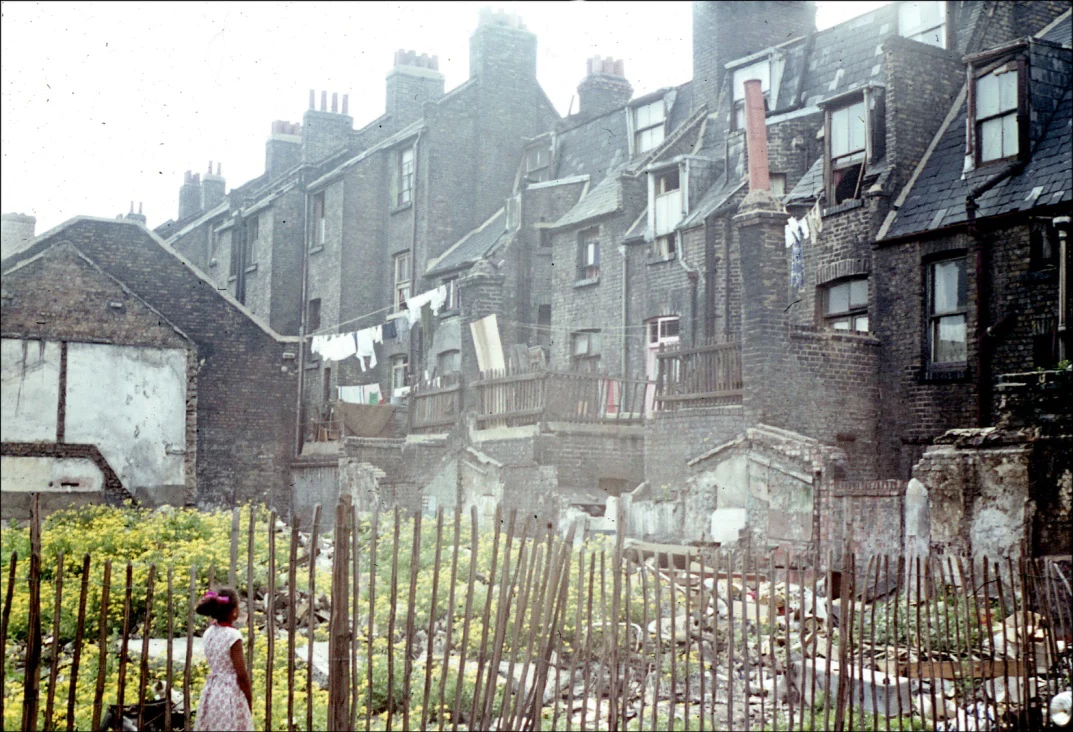
On over half of the bomb sites, Salisbury also found Oxford ragwort (Senecio squalidus), whose origins he traces to the volcanic slopes of Etna, in Sicily. There’s a record of a specimen being sent to Linnaeus from the Oxford Botanic Garden, suggesting that its method of dispersal from Sicily was not the wind, but the botanists themselves.10 The presence of Oxford ragwort and Rosebay willowherb suggested a pattern of plants that are tolerant of the byproducts of combustion left in the soil. However, not all the plants in the survey had some clear connection to fire. English oats were found growing in a number of the sites, prompting Salisbury to speculate that their seeds had been dispersed by the feedbags of London’s carriage horses. The soft fluffy seeds of Canadian fleabane (Conyza Canadensis; a.k.a. Erigeron Canadensis; a.k.a horseweed) were similarly dispersed not by fire but by transatlantic mail, as they were used as stuffing material in seventeenth-century taxidermy. According to Salisbury, “Patient Zero” was a stuffed parrot sent from Canada to Germany in 1686. The dispersal of Canadian fleabane was a botanical allegory that the Times of London couldn’t resist so close to VE day; in reporting on Salisbury’s lecture, that newspaper described it as subsequently arriving from Germany “by its own parachute.”
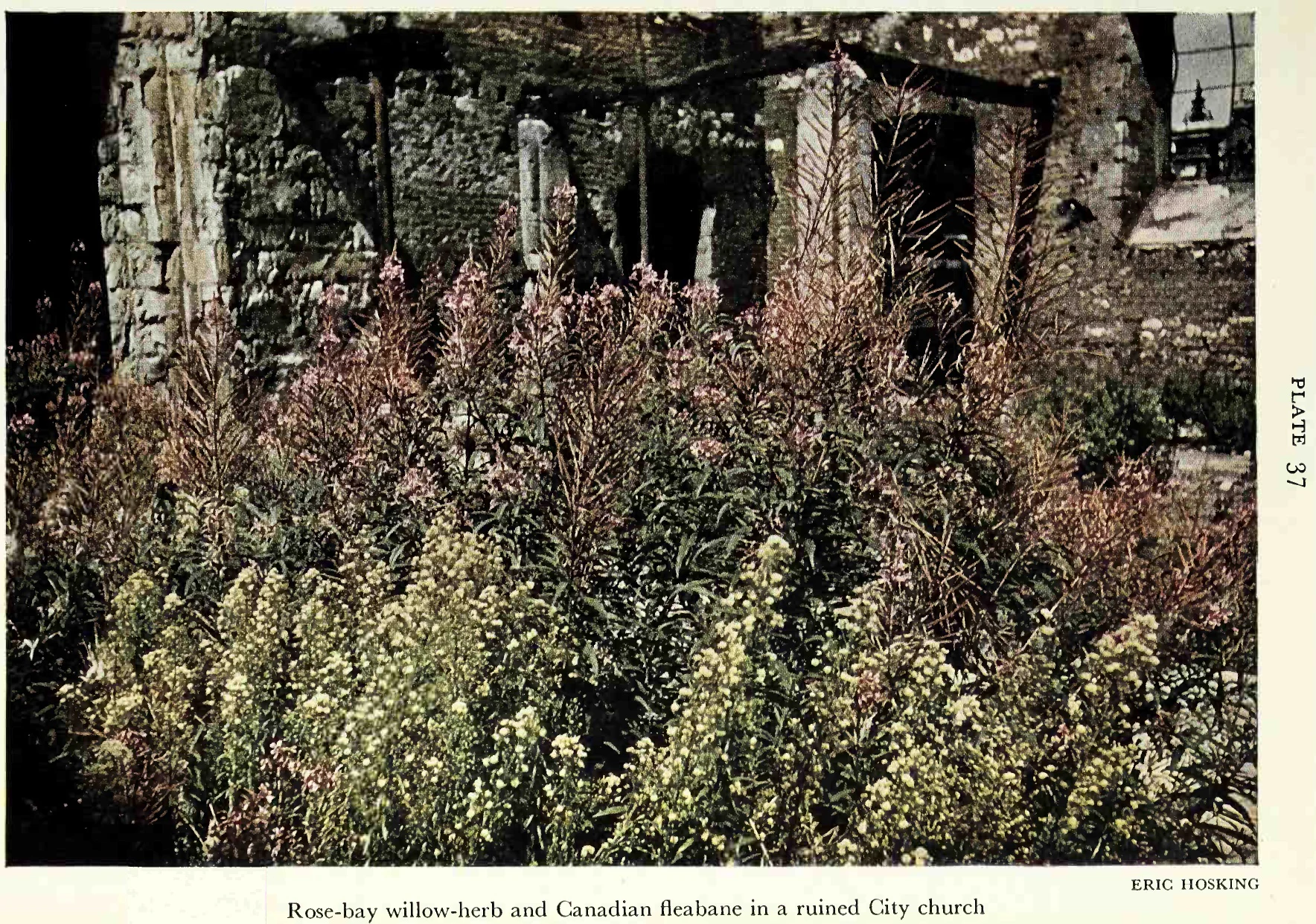
If Salisbury’s report on the Flora of Bombed Areas seems to continuously court allegorical interpretation, it is surely this compelling cast of characters that is to blame. There is the carriage horse that broadcasts seeds from it’s feedbag as it eats, the careless smoker who starts a heath fire with a cigarette flicked from a moving car, dozens of botanical curiosities who have somehow escaped captivity, a men’s fashion for trousers that may be to blame, and a taxidermied parrot known as Patient Zero. Narrative seems to spring from the soil of Salisbury’s terse scientific prose like a weed, but unlike Fitter, Salisbury resists these allegorical eruptions. His attendees may have been invited to sit in the ruins of the Savoy Chapel, but his botanical lecture leads them quickly and firmly away into the rigor of his methods, the nomenclature of his plants, and the numbers he has verified. If in Fitter’s Natural History we were left feeling patriotic, or saddened by war's casualties, how should we read Salisbury’s Flora of Bombed Areas? To put the question another way, if Salisbury was asking us to see London as the Rosebay willowherb saw it, the question still remains: what were we supposed to see?
Salisbury provides us with no hermeneutic key, as this is precisely what he is forbidden from doing as a scientist, as a Fellow of the Royal Society, and as an inheritor of the Enlightenment prohibition against subjectivity in the labour of interpretation. Metaphor, allegory, and above all politics are the negative image of scientific objectivity, against which good science is judged to be good. As Peter Galison and Lorraine Daston put it, “Objectivity is related to subjectivity as wax to seal, as hollow imprint to the bolder and more solid features of subjectivity.”11 What Salisbury can say objectively is directly related to what he cannot say, and must not say, about his work in London’s bomb sites. Like the scientists on the Intergovernmental Panel on Climate Change, Salisbury can spend years describing his data in detail, but is prohibited from saying what the data should mean to us, and can only watch helplessly as the task is taken up enthusiastically by journalists. In the capable hands of The Times of London, Salisbury’s scientistic title “The flora of bombed areas” is transformed into the melancholy headline “Flowers on bombed sites.” In the allegorical gap between these two titles, Salisbury finds himself in the position of Herman Melville, insisting that it’s just a story about a guy and a fish.12 In taking this position, Salisbury rigorously adheres to the aesthetic requirements of scientific objectivity, effectively shifting the burden of interpretation onto the reader, who can make of his evidence what she will.
Of course, metaphor and allegory are not the only ways to say what something means, but historically, these have been among the most powerful tools for doing so. Without these tools available to him, Salisbury’s “The flora of bombed areas” was left to be allegorized by writers who had only a passing familiarity with his work. Today, Salisbury’s war-time ecology deserves a better allegory than The Times of London was willing to write.
A far better allegory would begin with the assertion that “The flora of bombed areas” is not a story about hope, or new life springing from the ruins. The “Flowers on Bombed Sites” did not grow in memoriam of the dead. We know this because the first thing Salisbury shows us is that the bombing of London was a continuation of processes that were already ongoing in London since the seventeenth century. The urban transformations of London’s industrialization had already produced fire, ash, and bare soil, and for this reason the rosebay willowherb was already in London when the bombing started. In Salisbury’s study, the flora of bombed areas is revealed as simply the flora of modernity. This is to say that modernity was always a botanical project, and not simply an accidental one: botany was an engine of the modernizing project. As Donna Haraway writes: “My definition of modernity is that it is the period of the intensified transportation of seeds and genes.”13 This is why Salisbury’s title, “The flora of bombed areas”, should sound more striking to us than the headline The Times of London replaced it with. Places have always had a flora, in the geographical sense that every country or region has its own specific “flora.”14 However, Salisbury was offering a botanical survey not of a place but of a process. This is the flora that bombs make, re-read as the flora that modernity makes. Salisbury is showing us a botany that has been unmoored from the specificity and provincialism of the regional botanical survey. Instead, London’s bomb craters should be read as Salisbury’s Chimborazo profile; they are a site-specific microcosm of forces that determine botanical relationships at the scale of the Earth.15
The specificity of this flora should also mean something to us. What emerges from Salisbury’s survey is not simply a list of plants, but rather a list of environments, or plant-milieus. Salisbury doesn’t describe Oxford ragwort growing in London so much as Oxford ragwort growing in a set of conditions that the city has come to resemble. What we should see, therefore, is not a plant growing in some ruins, but rather a plant for whom London resembles a Sicilian volcano. In general, the discovery that the flora of modernity is interpreting our most beautiful cities as a glacial or volcanic aftermath should give us pause, because these are places that people in London don’t want to live.
That the director of Kew Gardens should be the one to deliver this message also means something. The colonial project of Kew Gardens is founded on the belief that all of the world’s environments can be approximated in London, through a mixture of botany, chemistry, and architecture. The Palm House, badly damaged in the bombing raids of ‘40 and ‘41, was one of Salisbury’s first restoration projects. If “The flora of bombed areas” had anything to teach Salisbury as he began his directorship of Kew Gardens, it would have been that palms can grow in London and that tropical environments are reproducible within the architecture of modernity, but only until someone bombs the palm house. This is to say that the relationship between a plant and its milieu is not deterministic. One plant does not belong to one environment forever. Oxford ragwort is not indexical of a volcano per se, but of all the things that happen on a volcano over thousands of years. If anything had ever happened on the volcano that the species couldn’t survive, then it would never have appeared in Salisbury’s survey. In this sense, a plant-milieu is not a place, but a set of environmental conditions over time; it is a process. If we can’t grow palms in London, it is because the systems that palms depend on to live in London are fragile over large timescales.
The allegorical lesson, then, of “The flora of bombed areas” is that we should aspire to live in cities capable of providing a milieu for plants as disinclined to catastrophe as we are. Surrounded by the 157 species on Salisbury’s survey, we are staring not at the Arcadia of Stowe but at the Hippocratic face of that Arcadia, at plants who specialize in catastrophe and are far better at it than the cities they live in.

Footnotes
-
Salisbury identifies rosebay willow-herb as Epilobium angustifolium in his paper; however, it is now more commonly identified as Chamaenerion angustifolium. This is the nomenclature that appears in the London Natural History Museum collection “Flora of London Bombed Sites” (1950). ↩
-
See “Flowers on bombed sites,” The Times, no. 50133, May 3, 1945, p. 2. ↩
-
For Walter Benjamin, ruins share an essential structure with allegorical thought. Like ruins, allegories appear in the aftermath of a process of destruction, in which the specificity or individuality of the world is broken apart in order to be reconstituted within a new narrative. In a ruin, as Benjamin notes, “history has physically merged into the setting,” see Walter Benjamin, The Origin of German Tragic Drama, trans. John Osborne (London; New York: Verso, [1928] 1998), p. 177. Salisbury’s invitation to see the ruins as futurity is therefore an invitation to allegorize something which is already (for Benjamin) an allegory. ↩
-
See Edward James Salisbury, “The flora of bombed areas,” Nature, no. 151 (April 24, 1943). Fitter published Salisbury’s complete list of plants that germinated in the bomb craters—157 species—as an appendix, in: Richard S. R. Fitter, London’s Natural History: the new naturalist a survey of british natural history (London: Collins, 1945). ↩
-
Richard S. R. Fitter, London’s Natural History, (London: Collins, 1945) p. 229. ↩
-
See Jakob von Uexküll, Streifzüge durch die Umwelten von Tieren und Menschen (Berlin: Verlag von Julius Springe, 1934), translated by Joseph D. O’Neil as A foray into the worlds of animals and humans (Minneapolis: University of Minnesota Press, 2010) ↩
-
Salisbury makes this claim in Sir Edward James Salisbury, Weeds & aliens: the new naturalist a survey of British natural history (London: Collins, 1961) p. 25. ↩
-
“Edaphic succession” refers to changes in the composition of plant communities that occur as a result of changes in the soil over time. The term was not taken up by Salisbury’s contemporaries, nor is it in use today. At the time when Salisbury was writing, plant succession was theorized as a process driven by modifications that plants themselves made to the environment. An example would be Frederic Clement’s theory of succession, in which trees convert a meadow into a forest over time by intercepting the light required by grasses, and thereby changing the pH of the soil. By using the term “edaphic succession” Salisbury is shifting causal agency from plants to soils. Today, this would be called “allogenic succession,” meaning succession driven by something other than living things. See Edward James Salisbury, “Note on the edaphic succession in some dune soils with special reference to the time factor,” Journal of Ecology 13 (2) (1925) pp. 322–328. ↩
-
Job Edward Lousley was working at the same time as Salisbury and also reported on the flora of bombed areas. Lousley noted that in the aftermath of the Blitz in 1943 the Daily Mail exhorted its readers to “Watch for Fire Flower,” which since the Great Fire of 1666 had referred to Sisymbrium irio, a.k.a London rocket. However, by 1945 it was what Salisbury termed Epilobium angustifolium, a.k.a fireweed (now Chamaenerion angustifolium) that had become the new fire flower in London. See Job Edward Lousley, “Flora of the bombed sites in the City of London in 1944,” Report of the Botanical Society & Exchange Club of the British Isles 12 (1946) pp. 875–883. ↩
-
Salisbury also found the “turn-ups” of trousers to be a possible dispersal mechanism, at least since they became a popular menswear fashion in the early twentieth century. Salisbury boasted that he once germinated 300 seeds collected from a single pair of pants. See Salisbury, Weeds & aliens, p. 105. ↩
-
As Daston and Galison explain, the result of this is that the history of objectivity is inextricable from the history of the self. See Lorraine Daston and Peter Galison, “The image of objectivity,” Representations 40 (1992) pp. 81–128. ↩
-
Melville famously warns us against reading Moby Dick as an allegory: “So ignorant are most landsmen of some of the plainest and most palpable wonders of the world, that without some hints touching the plain facts, historical and otherwise, of the fishery, they might scout at Moby Dick as a monstrous fable, or still worse and more detestable, a hideous and intolerable allegory.” See Herman Melville, Hershel Parker, and Harrison Hayford, Moby Dick (W.W. Norton, 2017) p. 195. ↩
-
See Donna Haraway and Thyrza Nichols Goodeve, How like a leaf: an interview with Thyrza Nichols Goodeve (New York: Routledge, 2000) p. 88. ↩
-
See for instance, Peter Sell and Gina Murrell’s 2010 Flora of Great Britain and Ireland, or John Pruski and Harold Robinson’s 2018 Flora Mesoamericana. ↩
-
In 1807 Alexander von Humboldt published a map of Mount Chimborazo, which he had climbed five years earlier in Ecuador. The mountain is drawn in section (or profile) and every plant that Humboldt found on Chimborazo is labeled at the altitude at which it grows. Humboldt was interested in Chimborazo because it was thought to be the highest mountain on earth, as well as the furthest geographical point from the earth’s centre given the earth’s equatorial bulge. For Humboldt, this location made Chimborazo a microcosm of all of the earth’s climate zones, from the equatorial tropics at the base of Chimborazo to the polar arctic at its summit. The plants that Humboldt found growing on Chimborazo were, in this sense, representative of botanical relationships at the scale of the earth. See Alexander von Humboldt, Aimé Bonpland, and Carlos Montúfar, “Journey towards the summit of Chimborazo, attempted on the 23rd June 1802,” translated by Helen Maria Williams, in Personal narrative of travels to the equinoctial regions of the new continent, during the years 1799–1804 (London: Longman, Rees, Orme, Brown, and Green, 1822). ↩